


“Hawthorn is the tree of May, of Beltane, and of new life…It is the tree of choice for fairy folk, and a single thorn standing alone upon a hill or near an ancient burial mound is never just a tree… it is a landmark between the visible and invisible worlds”
Jaqueline Memory Paterson (Tree Wisdom, 1996)
Close your eyes *
Now picture Dartmoor in your mind. Really try to call up images of the wild open spaces, the hills and valleys, the rivers and the sky. Chances are you probably thought of granite tors? or ponies? or possibly trees? And if you pictured trees in your mind, I’m willing to bet they might have been short and skeletal, windblown and sculpted? I’m willing to bet they were Hawthorns.
* I’ve just realised that starting a blog with “close your eyes” makes reading the actual blog pretty difficult, but you get the idea
Looking back over my photography, I’ve noticed that I’ve always been inspired by the Hawthorn tree. As a subject, it dominates my work and perhaps my enquiring mind, and at first I assumed it was just superficial. I mean, they do make great images and are absolutely symbiotic with their landscape. But over time, I have realised that it's a bit more than that, and on some level I feel drawn to them, there’s a connection to an older part of my brain, and so it only seems right that I devote this blog entirely to shooting this most magical of trees.
The hawthorn is an ancient tree. Really ancient. Fossil records show that its earliest ancestors date back to the Micoene period (23 - 5 million years ago), meaning that it was growing long before the ice age. Once the great thaw set in, the hawthorn was one of the primary colonisers of Western Europe and of the fledgling British Isles. Its seeds and fruitstones (haws) became a staple of early hunter-gatherers long before agriculture began. But the tree didn't just fuel the bellies of those early people, it fueled their minds and cultures too, becoming one of the keystones of western folklore and natural wisdom. Then, as now, the tree was a paradox - simultaneously a source of fertility and protection but also a harbinger of bad fortune and loss. A herald of spring and the natural world ,but a guardian of something altogether dark and other. It fruits with a knowledge that those who came before us held dear, respected, worshipped and revered. It has inspired poets and singers, heralds and healers. It really is no wonder it inspires this photographer too. But what do we really know about the tree?
Well on a purely factual basis, it's not a big, typically growing between 15 and 30ft tall. It is found all across the moor and whilst lowland varieties tend to be softer, those on Dartmoor are immediately recognisable for their dense network of tangled and interwoven branches and heavy windblown canopy. I really will try not to overuse the term “skeletal” but that is what they are, especially in the winter where their bare limbs take on a tortured appearance, bent by the howling gales, almost writhing for comfort and respite against the daily brutality they endure.
One of the tree’s key features is its trunk. As you would expect from a tree of this nature, it too is twisted and bleak. The bark is a dark reddish brown (keep that in mind when we look at photographing the tree later) and deeply cracked and grooved, the trunk often becoming multi stemmed. And of course, it is armed with thorns.
How odd then, that such a heavily armored, heavily armed tree, can also be so soft in the spring. Totally transformed by the warmer weather, it bursts into blossom in May - delicate white and pink petals forming amongst clusters of glossy bright green leaves. And when the summer starts to fade, the leaves turn an autumnal brown and flowers turn to oval shaped red berries.
The tree’s prevalence on Dartmoor is no accident, it is a result of a potent mixture of geology, climate and human history.
You won't find many broadleaf trees on the open moor. Oak, ash, beech and hazel have all struggled to establish, because the freezing conditions and Atlantic gales snap their tender branches and strip their larger leaves. But as we’ve seen, the more resilient hawthorn, with its dense interwoven canopy, deep roots and armored trunk, absorbs the worst, choosing to bend with the wind instead of breaking. And as humans took a hold on this landscape, this hardy specimen was their tree of choice. As the wilder moor was cultivated into field enclosures with granite walls (called newtakes), medieval farmers planted the hawthorn up into Quickthorn hedges - quick growing stock proof barriers. Over the centuries the walls and hedges deteriorated leaving just the ever resilient hawthorn behind, enduring markers of the long forgotten boundaries of that distant time.
And it's from this enduring past that the hawthorn’s role evolved. No longer just an agricultural tool or foodsource, its limbs reached into our consciousness and culture, taking root in customs and traditions that live on through the centuries and are as relevant today as they were a thousand years ago.
The Queen of the May is an old English tradition associated with Beltane and a sight familiar in villages throughout the land. The Queen is a young woman, elected to lead the spring procession and preside over dancing around the maypole - itself an act that symbolises the awakening of the earth after the long winter. She represents spring, fertility and rebirth often wearing a crown or wreath woven from fresh greenery and spring flowers. But the Queen of the May is also an old English name for the hawthorn, in reference to her blossom appearing reliably on or around the spring festival - tree and human together representing fertility, rebirth and life. That symbiosis goes further too, with hawthorn blossom being harvested on Beltane to decorate the maypole and crown, decking doorways to ward off evil spirits; the May Queen and her attendants washing their faces in may dew from the hawthorn leaf to ensure lasting beauty and youthfulness.
But that blossom has a darker side too. Bringing in the May referred to the mistaken act of harvesting the blossom and bringing it into the home. Doing so was considered a strict taboo, said to bring illness, bad luck or a death in the family.
Rebirth, fortune and beauty - Disease, misery and heartache - A tree of contrasts yet again.
The tree even made its way into more formal religion, with Christian legend holding that after the crucifixion, Joseph of Arimathea arrived at Glastonbury and planted his staff in the ground, whereupon it took root and blossomed into the famous Glastonbury Thorn which to this day flowers twice a year, in the spring and at Christmas.
But it’s the tree’s connection with the otherworld, for which the hawthorn is best known.
Whilst hawthorns grown in hedgerows were routinely pruned, a lone hawthorn (known as a Single or Solitary thorn) was considered sacred to the Sidhe - Fairies (or on Dartmoor, Pixies) - the “Good Neighbours".
The link with the hawthorn rests on a set of core symbolic and natural associations spanning Celtic, British and wider European folklore. Although there are regional and national variations, the central premise is that a lone hawthorn, standing in a field, on a hill or an ancient monument, was viewed as both a physical and spiritual threshold - usually marking a doorway between our world and theirs or as a meeting ground where the seasonal court of the pixie was held beneath the thorny canopy of the tree - especially on nights when the veil was at its thinnest - Beltane, Midsummer or Samhain.
So strong was this association that a strict taboo arose, in which deliberately harming, pruning or burning a hawthorn was believed to cause tremendous bad luck, incurring the wrath of the pixie resulting in failed crops, fallen livestock or severe illness in the family. Now, we may view this with scorn through our modern eyes - nothing more than a quaint tradition or a simple pastoral explanation for the naturally occurring blights that befall any farming community from time to time. Except, for some reason, the belief reaches out from the past and into our lives today. Take for example, the Latoon Fairy Bush. In the late 1990s, plans were drawn up for the construction of the M18 between Limerick and Ennis in County Clare, Ireland. The original route plotted the course of the road, straight through an unassuming hawthorn bush standing alone in a field in Latoon, leading to a furious backlash from farmers, residents and folklorists, led notably by the Irish historian and story teller, Eddie Lenihan. Their concerns quickly gathered traction, warning that the bush was sacred to the Sidhe and that harming it would result in car crashes and misfortune to anyone using the new road. Caving to public pressure, Clare County Council were forced to redesign the entire road which to this day splits and divides around the bush - the solitary hawthorn left standing safely on a grassy median strip in between high speed traffic lanes.
The hawthorn’s role as a gatekeeper to other worlds is a strong motif in literature too. Take for example:
“In the village of Kiltartan there was a white thorn tree that the others [the fairies] loved. An old man told me how he was passing it late one night when he heard the sweetest music coming out of its branches… for the Sidhe do not live only under the green mounds, but in the heart of the thorn trees themselves” W.B Yeats, “The Celtic Twilight" (1893)
Or
“Beneath the wild hawthorn tree, Where the moonbeams glint and gleam, The little folk of the shadow land, meet in a silver dream” Walter De la Mare “The Hawthorn” (1912)
Dartmoor is known for its folklore and legends, and especially those that relate to happenings beyond the veil. Tales of spectral hounds, giants, witches, the Devil, UFOs and of course the Beast of the Moor are littered across the national park, but it is the Pixie that wears the crown in these parts.
An early written record comes from Anna Eliza Bray. Her 1836 book, The Borders of the Tamar and the Tavy, collected local legends of the moor and in it, she wrote how moorland locals both feared and respected the lone Hawthorn tree and how it was common for travellers to wander off the track , near such trees, having become Pixie Led - deliberately drawn into peat bogs and boulder fields by the Good Neighbors.
Subsequent writings from Rachel Evans (Home Scenes, or Tavistock and its Vicinity -1846) and Robert Hunt (Popular Romances of the West of England -1865) collected similar rural wisdom warning against damaging a hawthorn or falling asleep under a hawthorn, for fear of retribution
But, as is often the case, it is to the esteemed chronicler of the moor, William Crossing, to whom we must turn for the definitive account and his 1890 book, Tales of the Dartmoor Pixies, perfectly sums up the hawthorn mythology of this land…
“ Many a story is told on Dartmoor, of the luckless traveler who, falling under the spell of the pixies, while passing some gnarled old May-Tree in the gathering dusk, has walked in circles for hours together, unable to find the familiar track, until he turned his coat inside-out”
So why have I spent so long looking at the fantastical folklore of the hawthorn? Well the answer brings us back to photography.
You see, anyone can take a photo of a tree. I mean, they aren't hard to find in the UK. A quick Google search tells me there are approximately 3.5 billion trees growing in our land - roughly 45 - 50 trees for every person who lives here. Not only are they plentiful, but they are always where you left them or expected them to be, so they make very easy and predictable subjects to photograph. But easy and predictable, rarely makes a good photograph.
Photography usually works best with some meaning involved. We talk a lot about composition and usually we mean the physical elements of a scene. What do we position where? Where is light coming from? Do we shoot high? Do we shoot low? And so on and so on and so on. But composition could also include mood and that's where your new found knowledge of the hawthorn can really supercharge your shots.
A quick recap for those of you who may have drifted off with the pixies…
The hawthorn is a dramatic tree. Its limbs are twisted, its back bent and shaped by the wind. Its form is skeletal (sorry - that one slipped through) in the winter but soft and full of blossom in the spring. It symbolises life and fertility, but is also linked to bad lack and ill health. And when it's growing on its own, we have a gurt big pixie problem.
And this naturally leads us to two types of shot.
The first is the more obvious, so let's dwell a while on the brutality. Dartmoor is, for the most part, a harsh landscape. It's windy, it's lonely, it's cold and it’s figuratively (and perhaps literally) a haunted place. So there is no better setting for an image that captures and compliments these moods and one that is tailor made for the twisted hawthorn.
Normally in these blogs, I direct you to some precise locations, from which to compose your shots, but I can't do that with the hawthorn. They are so ubiquitous on the moor that you won't have trouble finding them, so instead I want to describe a rather generic set of circumstances that you can work into your shot.
Start with the weather. We are looking for predominantly bleak conditions - dark, menacing clouds, fog, or maybe one of those glowing sunsets we get when a storm is about. You’ll probably have to suffer for your art, so dress up warm and brace yourself for the cold - your shot will need to look like it hurt!
Next, find your tree. We now know that a lone hawthorn is associated with dark deeds, so it stands to reason you want to find one that stands alone for that extra bit of atmosphere in the shot. Found it? Good, because now you need to think how to shoot it. As we saw, the tree isn't tall so there is a real danger that you could lose it against the background, so I almost always get very low to make sure that the canopy stands above the horizon. The trunk, as we saw, is also a key feature and the way the light plays on its gnarled and twisted bark is an essential element, and there are two ways you can maximise this. Either shoot with a wide lens (say between 10 - 35mm) and get in really close to the tree, or with a telephoto lens (300mm or more) so you can get in even closer but from a distance. It goes without saying you want to shoot with a shallow aperture (I tend to use around f/5) to make sure none of its detail gets lost.
Now think about the canopy. It will almost certainly be windblown, so you want to shoot either with the canopy distorting away from you or across you. Either of these directions will emphasise the shape of the tree, but if you shoot with it leaning towards you, that shape is bound to get lost. Now match the tree to the sky. This is the hardest bit and either takes real planning or real luck, but you want to try and shoot on a day (or from a position) where the clouds are moving in the same way as the tree is bending - that way, any movement in the sky or the grass will compliment the shape of the tree not work against it which could make the scene messy.
But I actually think that fog makes the best conditions for a brutalised shot. The fog wipes out all other distractions in the scene and paints everything in an eerie light. Add to this a twisted and (you guessed it) skeletal tree, limbs stretching and disappearing into the lonely gloom and you have all the moods you’ll ever need in one simple shot.
The other option is to forget the harshness completely and shoot the May Queen instead. Here, you can completely flip everything we just discussed, and head out on a warm, bright spring day when the colours are fresh and the sunlight sparkles. Now, the tree is decked in a head dress of vibrant green leaves and the soft white or pink blossom so associated with Beltane. Your aim now, as before but in more comfortable conditions, is to emphasise the season. So choose a bright sunny day, blue sky and fluffy clouds, or the golden hour light of an early summer evening. Use the same techniques to keep the canopy high and the trunk detail in focus. Make sure the light is catching the blossom (so the tree would need to be in full sunlight) and use other elements in your scene for added spring-ness. Lambs are plentiful at this time of year, and foals often shelter in the shade of a canopy (you actually do see this a lot). The bracken is also a fresh green now - just uncurling as the sunlight strengthens, really cementing the time of year.
A final option is to shoot at sunrise. This really works at any time of the year - bare limbs or full canopy, because the aim here is all about the rising light. You won't have long to work with, so find your tree and set up your shot before the sun clears the horizon. You’ll still be in the blue hour so the tree will look fairly lifeless, but provided you have positioned yourself so that you are around 90 degrees to the sun or even with the sun behind you (just watch out for your shadow); that will change as soon as it rises.
You are trying to make a feature of the way the golden light hits the trunk. When it is just a few degrees above the horizon, it is shining directly onto the tree’s bark. Because it is so short, you only have a few minutes before it gets to canopy height and the effect has gone, but if timed right, those minutes see it bathed in the most magical gold, which, if combined with the naturally reddish brown of the trunk with a dramatic sunrise sky, may just be the best conditions of all.
I said I wouldn't mention locations, but there are few notable spots you could try. Hound tor has a few very nicely sculpted hawthorns - not so much around the tor itself but closer to Greator Rocks and the slope to the medieval village. There is one very photogenic specimen high up on the slopes of Rippon Tor. This one works well because it has a beautiful drystone wall running alongside it you can find it here - ///gladiator.humans.copiers . It goes without saying that Emsworthy Rocks has a very famous hawthorn ( see my previous blog for the lowdown on this one), but do explore the mire too as the newtake has a number of other hawthorns that deserve some of your time. There are also plenty of options around Bench Tor and the Holne leat, Wind Tor has a good one too but it's hard to find much of a backdrop for it. And then, of course, we have the most famous of all. Combestone Tor has at least 5 hawthorns of varying sizes and each alone represents some of the very best on the moor. But taken together, you really have hawthorn heaven and is without doubt the best spot to bag your own shots. I have a three part blog on shooting Combestone so check that out for all your tips.
And if you do end up at Combestone, take a while to soak up the atmosphere. The area is said to be the home of pixies who live just below the rocks and gather there at night. One evening, on Walpurgis night (the night before Beltane) I was shooting the lone hawthorn at sunset, and whilst absolutely nothing of note happened, I never felt completely alone….

The last dusting of snow - 4th January 15:53, 23mm, f/3.5, ISO100

Combestone East Hawthorn at dawn – 14th December 08:24, 23mm, f/3.5, ISO100

Combestone West Hawthorns - Sunset Walpurgis night, 30th April 19:35, 21mm, f/22, ISO100

Rippon Tor Hawthorn and cold walls – 5th January 09:06, 14mm, f/5, ISO100

Last burst of the setting sun – 22nd June 19:40, 14mm, f/13, ISO100

Yar Tor Single Thorn sunset – 25th January, 16:43, 44mm, f/5, ISO100

The Queen of the May - 20th May 19:00, 110mm, f/4.5, ISO100

Fresh spring sunrise - Mel Tor - 26th May 06:00, 14mm, f/18, ISO100

Autumn on Hound Tor, 13th October, 07:14, 20mm, f/18, ISO100

Skeletal! Combestone North , 11 April, 06:10, 18mm, f/22, ISO100
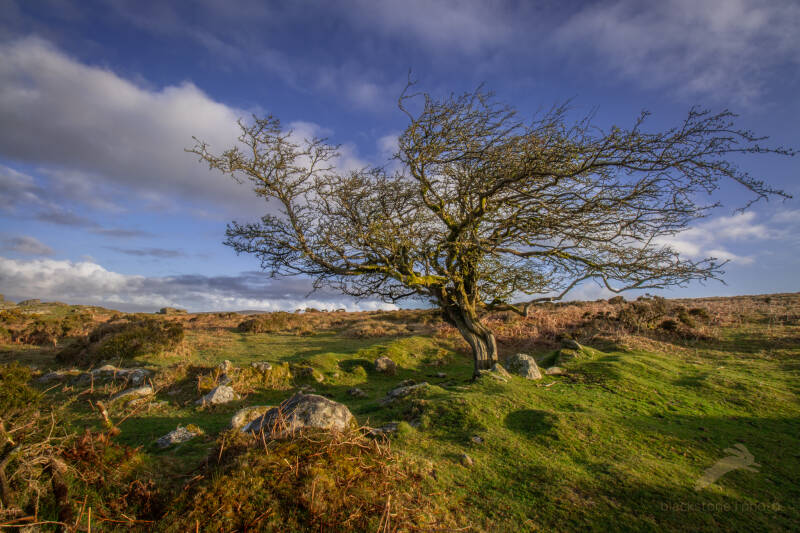
Spring greens - Pil Tor, 13th March, 07.:30, 15mm, f/14, ISO100
Add comment
Comments