

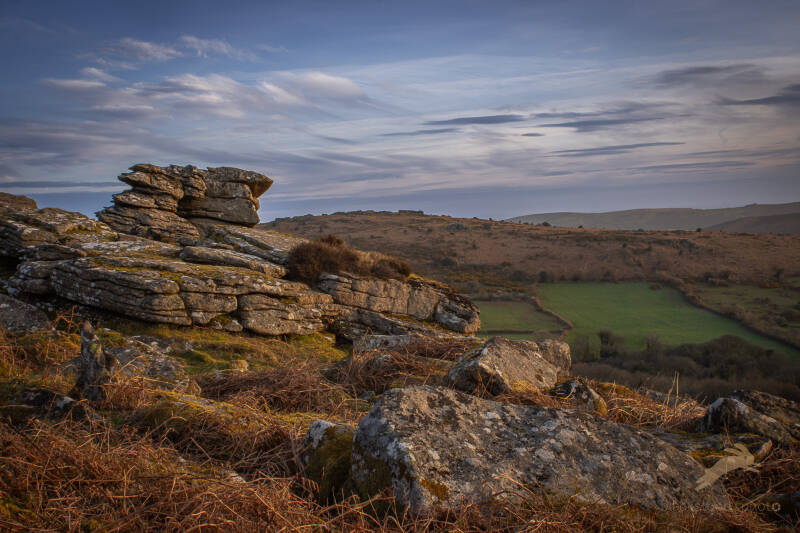
“ Dartmoor has always been a source of great joy, comfort and soulfulness to me. I delight in the changing moods of the moor, from those wonderful days of sunshine to the glowering fogs, and the shifting scenery from the wooded valleys to the wide open moorland”
Simon Hall
Over the last year, I’ve really enjoyed writing these Dartmoor photography blogs, and if they have been useful to just one person, it's all been worthwhile. But recently, I was invited to contribute to the excellent new Our Dartmoor website, and in writing my introduction, it made me revisit my original plan - to help people who are new to photographing Dartmoor - and I realised that perhaps I haven't quite done that yet. So this blog is aimed at the absolute beginner - if you are a more experienced moorland photographer, this one may not be for you, so feel free to skip it, and I’ll see you in the next one. In this blog post, I can also finally reveal the details and dates for my new photography workshops. Read on to find out more!
Well, where do we begin?
I suppose the first thing to ask is “why Dartmoor?” and it's a good question. Let’s be honest, from a photography point of view, Dartmoor isn't for everyone. Without stating the obvious (which is exactly what I'm about to do), there are no cities or coastlines on the moor, so if you are drawn to urban photography or seascapes, it’s probably not going to work for you! But one of the great misconceptions is that Dartmoor is only good for landscape photography. I mean, it is - it's what I do after all, but it's good for almost every other style of photography too. Long exposure, portrait, wildlife, architecture, history and folklore, lifestyle, people, weddings, activities and action - the list goes on.
But I'm a landscape photographer, and that, of course, is Dartmoor’s greatest gift to enjoy.
Photography, like any art form, is all about individual expression. There is no right or wrong way to take photos, and please don't let anyone tell you differently. But photography is also about capturing character and presence, light and shade. All of the UK’s national parks are different, and each has its own personality. Whilst Dartmoor doesn't have the vast ranges of the Lakes, or the peaks of the Cairngorms or Bannau Brycheiniog, it certainly has its own identity, which you can use to give your shots a real sense of place.
Quite simply, Dartmoor is wild. Its spirit, its very essence, is found in the rocks that spring from the ground, the wind that sculpts the trees, the light that paints its hillsides, the rivers that give it life. It's found in the ponies that roam the plains, in the ravens that croak from its tors, in the curlews that cry from its mires, in the twisted oaks that cling to its steep valleys. And this is your canvas - these are your tools. Use them to suit your style - go big if you want to emphasise vast spaces and skies, go close up if you want to focus on characters and portraits, get out in the rain if you want your shot to look brutal, bask on the sunlit granite if you want a golden sunset. They are all there; you just need to go and find them. And that's where the fun lies.
The first thing I would say, if you are new to Dartmoor, is don't be afraid of it. Sure, it can seem daunting if you aren't used to such wild open spaces, and to be absolutely clear, it can be a hazardous place, but with a little common sense and a lot of adventurous spirit, it is far more accessible than you might think.
Broadly, the moor is split into four quarters. The north is rugged and remote, the south is lonely, but its fringes are nicely wooded, the west is epic in scale, while the east is slightly more pastoral and combines many of the features of the other three. For me, east or west are the best places to start because they have a little more infrastructure that can make those first steps a bit easier to take. Don't run before you can walk on Dartmoor. There are plenty of well populated areas that are easily accessible from your car, meaning that you don't have to be a seasoned hiker to reach the best photography spots - locations like Haytor, Hound Tor, The Dart Valley, Burrator Reservoir, Windy Cross, Bellever forest, Foggintor Quarry, Nun’s Cross Farm and Brentor Church are immensely photogenic giving you hours and hours of repeat visits throughout the seasons, but all have car parks, many have toilets, most have cafes near by. Roads are fairly wide, paths are sound, and most can be reached in less than 30 minutes' walk. Use these locations to get comfortable - the moor can be a lonely place even in the more popular spots, but for most of us, that is also the appeal! And when you are ready (you’ll know when the time is right) you can start to venture further afield.
So a word on safety. In my real job, I am a safety manager for a leading conservation charity. We work on Dartmoor and in remote, rural locations around Devon. I'm a Technical Member of IOSH (The Institute of Occupational Safety and Health), and I’ve spent the past twenty years keeping people safe in remote and wild environments. These places can be hazardous, but that can be controlled with a bit of thought, common sense and planning.
The main risks on Dartmoor are the weather and the terrain (ok - they are both pretty significant!). In some of my other blogs, I’ve talked about how quickly the conditions can change, and that is part of the appeal to the photographer. But just because it's sunny and calm when you set out from your car, doesn't mean it will stay that way - winds get up, fog descends from nowhere, and it almost always rains at some point! So prepare. Check your weather apps closely and use reliable ones - most people who work in outdoor industries favour the Met Office, and I would agree. Consider the Weather Channel app too - it's just been rated the most accurate by Which, so it's worth using too. Even with a reliable app, Dartmoor has its own climate and weather systems, so the most reliable indicators are your eyes and your instincts. If it doesn't feel right - don't head out. If you are already out and the weather is starting to change, turn around and head back.
The weather really is a double-edged sword for the photographer, though. One of Dartmoor’s greatest photography assets is the contrast between conditions. The stormy skies can make the very best Dartmoor photos, enhancing and emphasising the brutalism of the landscape, but are likely to leave you drenched and cold. The deep snow drifts are picture perfect, but the roads can be lethal and untreated. Even the deep blue sky of a summer’s day can leave you sore from the sun - there is very little shelter up here after all!
So just be sensible. Don't underestimate the weather gods. They take no prisoners in a land like this. Plan your photo shoot in conditions you are comfortable with, and if in doubt, don't go out - or at least stick to well-defined paths, stay close to the car or more populated areas.
It goes without saying that the high moor locations will be more treacherous in bad weather, so another technique, if you want to get out with the camera when the weather isn't on your side, would be to head for the river valleys on the fringes of the moor. Conditions will usually be much more benign and sheltered there.
You've got to think about the terrain too. Dartmoor is littered with rocks, and there is literally nowhere that is flat. Even the flat bits aren't flat!! Expect the ground to be uneven, slippery and steep. But again, you can prepare for this. Research your planned locations, and if you aren't as confident, stick to places with good footpaths. The National Park website has loads of accessibility information. And if you are venturing out a little bit further, make sure you have good walking boots and avoid boggy ground. But I’ll say again, you really don’t have to venture far. Two of my favourite spots are Saddle Tor and Emsworthy Rocks, and you can shoot both of them whilst still within sight of your car.
The last thing I want to say on safety is about ticks. I have specialised in the management of Lyme Disease over the years because I have seen firsthand what it can do to people. Lyme is contracted through the bite of infected ticks, which sadly thrive in locations like Dartmoor. Long grass and vegetation are the high-risk areas as the tick mantles on the tips of the foliage, waiting for an unsuspecting mammal to brush past. If one latches onto you, it can pass the bacteria that cause Lyme into your bloodstream and make you very ill if left untreated. Not all ticks carry the disease, but many do, so you have to consider this a very real risk. Thankfully, Lyme can be easily treated with antibiotics and the best way to avoid picking them up is to stick to footpaths and short vegetation, cover up with long, tight-fitting clothing, and when you get home, check all over to see if you have picked any up. If you do, remove them immediately. You can find some excellent advice and guidance on staying tick safe here
So if that hasn't put you off, let's look at some photography.
I’ll start with the seasons.
Typically, winter on the moor is brutal. It's cold, it's wet, and it is very windy too. But these seasonal conditions give your shot identity, and my favourite will always be an angry, brooding sky with a granite outcrop or skeletal tree in the foreground. Sunrise can be great at this time of year, too, and if the conditions are right, the vibrant pinks and purples of a winter dawn go unmatched for the rest of the year. The holy grail, of course, is snow. We usually get a few good snow days a year, so if you can, definitely use them; you won't be disappointed.
Spring sees the return of life - hawthorn blossom, bluebells, lambs and foals. Typically arriving later up here than down in the lowlands, your spring shots can start with lambs in March, the blossom and bluebells won't appear until May time, and the foals start to become more prevalent from early June.
Summer can be a tricky season on the moor. An explosion in visitors makes it harder to keep people out of your images, and the sky is often gin clear - great for sunbathing but not so good for any interest in your shots. Sunrise is ridiculously early now, so I would suggest aiming for the golden hour of a sunset - after spending the winter and spring trying to keep the camera still in howling winds and shivering hands, there is nothing nicer than watching the sun go down, perched on granite that still holds warmth from the day. For all her brutal majesty, I've never found anywhere that does soft, tranquillity better than Dartmoor on a summer evening.
Autumn is a good one. From late August through to mid-September, the moors are carpeted in purple and gold, and mist hangs low over the tors. As we push on through the season, the leaves turn vibrant orange, and the valleys come alive as the rivers swell and leaves turn bronze. The golden hours at both ends of the day are at their most rewarding, too. Not too early, not too late and when the cloud isn't too heavy, you get truly epic sunrise and sunset skies.
Composition is harder to discuss because it is so personal. You will find your own style and adapt it, but typically, Dartmoor shots tend to embrace those elements that make it unique - Ponies, Tors, Granite, wide open spaces and big skies. Perhaps the most useful thing I can do is to tell you how I go about composing a typical Dartmoor shot.
It always starts with the sky. I plan everything around the sky, as I always like it to be the predominant feature in my image. Dartmoor shots tend to work best when they are dramatic, so if I’m planning a sunrise or sunset, I look for around 30-40% cloud cover. Shots at this time of the day work when the low sun reflects off the clouds, and the closer it is to the horizon, the greater the effect. Anything more than around 40% cloud cover runs the risk of the sun being completely hidden and might ruin your shot. Typically, if the sky is spectacular, I like it to take up at least a third of my composition - sometimes more if it's worth it. Next, find a subject to anchor the foreground of your shot. There are many striking subjects to choose from, but my favourites are rocks or trees. Get low enough so that they are prominent against the sky (shoot from too high up, and they will get lost against the background) and look at how the light hits them. The gnarled bark of the Hawthorn is good for this, but it is the granite - so prominent on the moor - that should always be the star of your shot.
At first glance, granite makes a very dull subject. When it’s not in direct sunlight, this hard igneous rock is just not worth shooting. It literally sucks the colour from your image and can leave very dark, unbalanced areas across the scene. But granite is formed of slivers of quartz and metal oxides (its very name coming from the Latin granum meaning grain), and in the right conditions, it comes to life before your eyes. The best time to shoot it is when the sun is right on the horizon. At dawn, the rising sun picks out the quartz and makes it sparkle, bathed in a warm golden glow. At sunset, the setting sun highlights the oxides, turning the rocks a rose gold. These moments are fleeting - maybe lasting only 30 seconds a day, but they really are as precious as the rock itself. My advice would be to plan your shot in advance, set everything up and be patient - watch the light start to grow or fade, notice how the rocks are changing and be ready to shoot. While you wait, check and double-check your camera settings - you want everything to be right for those few seconds. This is much easier to do on a warm summer evening as you wait for the sun to set than on a cold winter morning as you wait for it to rise, but both are as spectacular and rewarding.
There is a saying that there is no such thing as bad weather, just the wrong clothes, and that can be adapted to your photography, too. Whilst we all want the stunning conditions, the truth is that Dartmoor is a temperamental beast and if you only have a few hours a week to spare, more often than not, you’ll get clouds, rain and fog. But don't let that put you off, you just need to be creative with your composition. If the sky looks stormy, shoot for a moody sky over distant hills. If you have boring blanket grey clouds, head to the river valleys and consider experimenting with long exposure. If you have empty blue sky, head to a pine forest and play around with shadows. My worst photography habit is being too inflexible. If the conditions aren't what I expected, I end up sulking and not thinking outside the box. The more you get to know the moor, the easier this becomes. Have a backup plan (and maybe a backup of your backup plan) and be prepared to revert to plan B or C if plan A doesn't work. I really should take my own advice here!
And what about your camera? Well, I want to dispel a myth that you have to have fancy kit. Of course, I do shoot with a DSLR, and as you become more adept at photography, I think the pleasure comes from learning how to master your equipment properly - how different combinations and techniques bring new and improving results to your work. When I started out, I didn't understand terms like ISO, depth of field or the rule of thirds, and so I just concentrated on what looked good to me instead. I had very basic equipment, and so I just focused on what looked right. And you know what the best thing is for that? A camera phone. I'm saying it here and now: if you don't have a camera, just use your phone. Learn what looks good to you, learn about light, learn how it brings the rocks and trees to life, watch how the seasons change and work out what you like in a shot. Get down low, get close up - it can all be done with your phone, and I really do think it is a wonderful tool to help you to start thinking like a photographer. And when you are ready, you can upgrade, but don't ever feel inferior if you shoot with your phone - I’ve taken some lovely shots on mine, and it's always with you. In fact, my most popular shot of 2025 was taken on my iPhone! Indeed, as my photography workshops develop, I plan to run a lesson purely for camera phone users.
Once you are confident enough to explore and you've got an idea about your style of photography, you need to think about location. I find this quite an interesting subject, because after all these years of working on the moor, I’ve only just worked out how to do this, and it's changed my photography completely.
The mistake I used to make was to go to a location just to shoot it. I shoot at the weekend, and my planning usually starts early in the week, as I keep an eye on the conditions and then refine my list of potential locations to match the style of the shot and the expected weather. That left me quite restricted, and I would tend to head out with a fixed mindset - the shot already visualised in my head and frequently disappointed when things didn't go to plan. I’d also get a bit bored and lose inspiration visiting the same places and shooting the same scenes time and again. Over time, I realised things had to change. I was falling out of love with photography, and my work was suffering. After a lot of self-reflection, I started to understand that my best shots happened far more organically, and the most rewarding images came from the times when scenes just appeared to me. A switch flicked in my brain, and I started to make the change. Now, I still plan an area to work in, but I go there with no expectation in mind. I just get out of the car and go for a walk to see what I can find. This challenges me to look harder, to think more creatively. Rather than shoot the thing I had expected to see, I now look at how elements line up, how they look from different angles. I might see one small rock that catches the light just right, or I might notice a tree I’d never seen before. Shapes in the drystone walls, a five-bar gate opening into a panoramic view, the way a distant hill is silhouetted, streams that lead the eye, a foal taking its first steps, a raven parched on a cross… the list goes on. So perhaps my most useful piece of advice is to completely free up your mind and get out, explore and engage with no expectations. Nature is a gift, so look and really see - you’ll be amazed at just how much there is to find.
Finally, a word on clothing. Don't overlook this. In the summer, it's quite easy as the moor is usually gentle with you - sunglasses, a hat and suncream are really all you need (note - please do wear more than that - the gorse is not kind on nudists!). The winter (and to some extent spring and autumn) are different prospects altogether. Layer up and make sure you have waterproofs unless there is no prospect of rain. But gloves are the most important thing of all for the photographer. You kind of need to be able to press buttons, touch screens and adjust settings all the time, and if your fingers are too cold, nothing will work - trust me, I have messed up many shoots over the years by just being too cold to work. Don't cut corners on your clothing and footwear, and you’ll be fine.
So, what to do with all this advice?
Well, as I said in my first-ever blog, I’m really interested in helping people start out on their photography journey. I always had a long-term plan to start offering workshops, but I’ve just had a major milestone birthday (obviously my 21st!!), and I started to think “if not now, then when”. So I’ve brought things forward.
Many photographers offer workshops on Dartmoor, but I want to do something new. I want to offer workshops solely aimed at the beginner - there is no elitism here. My workshops are open to anyone starting out in photography - from the person who has never been on Dartmoor before, to the person who only shoots images on their mobile phone. From the person who has just got their first DSLR and doesn't know what to do with it, to the person who just wants to go on a walk and take a few snapshots as they go. I’m a born and bred Devonian. My family have lived and worked on the moors, I've grown up on it, read about, walked it and photographed it all my life, and I think I can pass that passion and knowledge on to a whole raft of budding photographers who might otherwise be put off.
My first workshop is on 6th June 2026, with additional workshops over the summer on 7th August and 6th September. I'm still working on the exact content, but if this blog spoke to you, then the workshops will definitely be for you. I’ll be covering how to make the most of your camera, photography basics, how to plan your shots, how to read the conditions and most importantly, how to compose stunning images of the moors. I want each workshop to feel safe and welcoming, and I want to be able to give each budding photographer my time and attention, so places are limited to just 4 people per workshop and priced at £45 per person. Each workshop will last three hours.
All you need is a camera - any camera. We will be covering basic camera settings and principles around aperture and shutter speed, and whilst some very basic cameras may not give you the option to alter these settings, most will. The majority of the workshop will concentrate on how to construct an image, and work with the light and weather and of course, how to shoot Dartmoor, and you can do this with any camera at all. We will be working in carefully chosen locations in East Dartmoor. Areas will be accessible and fairly level but moorland terrain is always tricky, so a good level of mobility is important. You will also need to dress for the conditions too, but all the information you need will be provided when you book.
To secure your spot, head over to the X page on this website and use the contact form to get in touch. More workshops will be added later this year - I am planning on creating a session purely for mobile phone camera users and another as an introduction to long exposure photography.
I look forward to seeing you out on the moor.
Add comment
Comments