


Sharp Tor wreathed in autumn colours, shot from Venford Brook - 19th October, 16:25, 55mm, f/16, ISO 100
“I have never before, in my long and eclectic career, been gifted with such an abundance of natural beauty as I experienced filming Warhorse on Dartmoor”
Stephen Spielberg - Director - Warhorse
In life, it doesn't pay to have favorites. It never ends well.
Dartmoor, for those who don't know, is perhaps best known for its tors - granite outcrops that shape the landscape, with over 160 listed as significant or named. As a Dartmoor photographer, I often get asked which tor is my favorite, and with so much choice on offer, I’ve always found it a hard one to answer.
Some, like Vixen Tor, Hound Tor, Great Mis Tor and of course Haytor are simply iconic. Others like Honeybag and King Tor are vast. Wind Tor, Pil Tor and Bench Tor are small but perfectly formed, whilst others like Combestone Tor, Rippon Tor and Yar Tor command the most imperious views. But high above the Dart Valley, sits one tor that features very prominently in my work, I find myself inexplicably drawn to it - think Richard Dreyfuss to Devil’s Tower or Gollum to his precious. It is called Sharp Tor and over the years, I've come to realise that it probably is my favorite tor on the moors.
Sharp tor is, according to William Crossing, one of ten Dartmoor tors to bear that name. Situated between Poundsgate and Dartmeet (also known as Badgers Holt), it is instantly recognisable - shaped like a child’s drawing of a mountain, a perfect alpine peak that dominates this part of the skyline, quite different from all those around it.
One of the essential elements of photography is mood, and there is something very old, a most eldritch atmosphere, that clings to Sharp Tor’s slopes. It seeps from the soil of this part of the moors. I’ve written previously that it is my lifelong interest in folklore, myth and general esoteria that first drew me to Dartmoor. I grew up on the books of Chips Barber and Derek Underwood and immersed myself in local legends whilst attending Widecombe Primary School as part of a student exchange program. It is fair to say that Dartmoor’s lore has become a part of my DNA and i’m always looking for ways to build it into my images - the Hawthorn that guards the pixie realm, the stones that bore witness to ritual, the hounds and witches that haunt the lonely granite piles. And it's that energy, so abundant here, that supercharges the potential for some really atmospheric compositions around Sharp Tor which, as we shall see, may be about to catapult it onto the world’s stage.
So before we consider how to photograph it, lets stop a while and consider some of the folklore that surrounds the area.
The tor’s deepest flank rises up from the Dart Valley and it is here that Rowbrook Farm can be found. The only property in the vicinity, it was once the home of Jan Coo who mysteriously vanished after hearing the fabled Cry of the Dart. Some say he was a changeling, others that his soul was claimed by the old River Gods of the Dart. Whatever fate he met, his is one of the most interesting stories of the moor and you can read about it in more depth in my Combestone Tor (North) blog.
Slightly to the east of the tor stands Mel Tor, a good photography location in its own right, and one with a very interesting history. Crossing refers to it as Mil Tor, the name perhaps in reference to its position in the middle of Sharp Tor and Bell Tor; but over the years its name has evolved to Mel, the name I shall use going forward. Mel Tor was the site of an age-old pagan custom known as the Rolling of the Wagon Wheels. This was a ritual that predicted the forthcoming harvest, in which the parishioners of nearby Leusdon would gather on the tor and pack straw around a wagon wheel. The straw was lit and the flaming wheel rolled down the steep slopes towards the river Dart, flowing through the valley far below. If the fires went out before the wheel reached the Dart, it was the sign of a poor harvest to come, but if the wheel stayed alight a bountiful haul was promised - the old Gods again flexing their muscles and influence in this region.
Sharp Tor’s opposite flank, leads away down to Dartmeet, and here sits the coffin stone - a granite slab, which also suffered at the hands of divine intervention. In her book The Witchcraft and Folklore of Dartmoor, Ruth St.Leger-Gordon tells us that “the stone is comprised of two contiguous granite slabs, upon which it was customary for weary bearers to rest their burden when carrying a coffin for burial in Widecombe churchyard…. Here the funeral party halted for much needed rest and refreshment…. Tradition has it that the two rocks, originally one, were cleft by a thunderbolt when the coffin of an unusually wicked character was rested there on his last journey”
Meanwhile, just down the road at Poundsgate, stands the Tavistock inn, where, on 21st October 1638, the Devil called in to get directions to Widecombe (Google maps having not been available at that point) en route to collect the soul of tin miner Jan Reynolds. Further on still is Ponsworthy where Joey Brown encountered a demonic black dog (known in these parts as a Wisht Hound) whilst winding his way home from the nearby Forest Inn.
So its plain to see there is something a bit special about this part of the moor - an energy and character that perhaps elevates it from other locations and whether it comes from the river spirits, pixies, black dogs or the Devil himself , you can certainly harness its energy into your photography. And this cinematic quality is precisely why I used that quote from Spielberg at the start of this post.
You see, whilst Spielberg was talking about Dartmoor in general, the Director Robert Eggers, has channeled the rich folklore and cinematic qualities of the tor itself into his latest horror movie Werwulf, shot on location at Sharp Tor. Indeed it was fascinating to spend time over the winter, watching the set being built - an entire cottage constructed on the slopes of the tor - complete with fleets of trucks, lighting rigs, extras on horseback and A list celebrities like Willem Dafoe and Aaron Taylor-Johnson in our little corner of the moor. It looks like this movie could be huge, with the recently released trailer amassing over 60 million views in under a week. Set for release in late 2026, it will be quite something to see my favorite tor, right there on the silver screen.
But now the Hollywood machine has gone, the tor has resumed its quiet vigil over the Dart Valley. It is both wild and tamed - easily accessible from the B-road that cuts across the moor from Newton Abbot to Tavistock and is only a short drive from Ashburton, Princetown and Widecombe, and yet it is also remote - high and silent with far reaching views, just the wind whistling in the lone hawthorns. And as the peace returns, we can start to shoot it again.
Some of Dartmoor’s tors make great subjects when shot from a distance but are a little disappointing when shot at close range. Hound Tor may be the best example of this. Others aren't particularly striking to look at but are intricate and detailed up close (like nearby Yar Tor). Sharp Tor though, stands out because it excels in both - dramatic from afar with a myriad of compositions to discover on its flanks and peak.
So let's start with shooting from a distance.
I think there are two distinct options here. The first is to shoot Sharp Tor from the opposite side of the Dart Valley. This works well because the distinctive shape of the tor rises out of the thick tree canopy of the northern valley slope, giving you excellent foreground color in the spring, summer and best of all, autumn. I prefer this position towards the end of the day when the setting sun really illuminates the slopes and foliage, but you could also try the same composition at sunrise, where you get the added bonus of the dawn chorus in the river valley - so spectacular here, that Hamza Yassin featured it in his recent BBC Hidden Wild Isles series.
You can pretty much line this shot up anywhere from Bench Tor in the east, to Combestone Tor in the west, but the location I like best is Venford Brook. There are several car parks around Venford Reservoir which you can use as your base. The brook flows from the reservoir into the River Dart, so you want to position yourself so that you are looking downstream with the brook on your left hand side (you cant see Sharp Tor if the brook is on your right!). Leave the road at What3Words location - hurricane.fussy.radically and follow the obvious fence line out across the moor. Eventually it will drop sharply down hill at the end of the waterworks buildings (What3Words location - slant.haggis.frame ) and you will come to the brook. Almost immediately you are surrounded by moss covered boulders and enveloped in ancient twisted oaks that evoke Tolkien’s Rivendell or Conan-Doyle’s Lost World. Follow the well defined path along the side of the brook for around 500m and your view up to Sharp Tor will appear. Spend some time here playing with composition. You can get up above the path if you want the tor a little lower in your shot, get down below the path if you want more tree canopy foreground or just stay on the path and use it as a leading line towards the tor itself. They all work. While you are here, you really should check out Dartmoor’s most photographed waterfall - Venford falls. It's just a stones throw from here and a location I have used a lot over the years, so much so, it deserves its own blog which I must get round to writing soon.
Whilst you are over this side of the Dart, there is another composition you could try. For me, it stings a little as I have never been able to properly capture it and it joins my list of other photographic White Whales - Yar Tor’s spiral cairn, Emsworthy’s lone Hawthorne, the spire of St.Pancras in the mist - but don't let that put you off, the setting and the potential payoff could be great if you can work the elements out. To find it, head back to the main road and across the Venford dam, past the car park and follow the road slightly uphill. After a short while you will come to a raised drain cover on a rectangular concrete plinth (stay with me, it gets better) at What3Words location - mission.dunes.differ. This marks the point that the Holne Leat goes under the road - turn and follow the leat downstream a little and you will see it aligns perfectly with Sharp Tor. You’ll immediately see the opportunities for a good composition here - the leat giving you a solid leading line, the rushes and pasture giving foreground interest, all leading the eye to the tor giving you a dramatic mid ground horizon. But these elements have always conspired to frustrate me and the images I’ve taken here, never reflect the majesty of the scene when seen through the naked eye. I think the problem is that the obvious subject is the domination of the tor over all it surrounds - from here it looks mighty and regal, the undoubted star of the scene. But to combine all these foreground elements, you have to shoot at quite a wide angle (maybe 20-50mm) and the effect this has, reduces the tor to a mere molehill. Maybe I just need to be more creative at this location, and maybe I should stop moaning that there are just too many lovely things to shoot in one scene. Give it a go yourself and if you pull the shot off, I’d love to hear about how you did it, in the comments section below.
When you are done here, jump back in the car and take the short drive across the Dart (either via Huccaby Bridge at Hexworthy or New Bridge below Holne, and head to Yar Tor - the best spot to shoot Sharp Tor looking south, and to base yourself for a closer inspection of the tor itself.
Park at the obvious (but very small) car parking area - you can find the details of its location in my Yar Tor blog - and look south to Sharp Tor. You’ll notice immediately that your view is completely different from this angle. Whereas the view from across the Dart Valley is quite intimate, your composition being tightly framed by the trees and the tor looking above you; from Yar Tor you are are on more of a level with the summit of the tor and it now sits framed against the brooding hulk of Holne Moor, and, from some angles, deep into the South Hams far beyond. Before heading down to explore the tor though, I recommend trying two more distant compositions first.
Corndon Tor is a short stroll away, up a fairly gentle incline. From the parking area, cross the road and head uphill past the Cave-Penny Cross. Follow the obvious path up the slope until you come to a small tor at the top of the hill. From here, you are now definitely higher than Sharp Tor, but your angle frames it really nicely against Venford Reservoir. Because of your position and distance from the tor, you really need a telephoto lens to keep the sense of perspective. Anything less than about 200mm means the tor looks too small - pretty much the same problem I described from Holne Leat earlier in this blog. But with a telephoto you can get a really nice sense of depth especially when shooting at a low f/number. I really like to use this location in late summer. Because of the position of the rising and setting sun at this time of year, it really works best at sunset, where the warming rays beam in from the west, bathing the purple and yellow slopes that stretch from Corndon Tor in a sea of liquid gold. This really is a wonderful composition and when the elements combine, you’ll pinch yourself to see if you are dreaming - the soft sunset sky in the top third of your shot, the dramatic tor with the reservoir sleeping peacefully in the mid ground, whilst the vibrant blossoms dominate your lower third foreground, all washed with that miller time golden glow.
The alternative to Corndon is Yar Tor. Slightly lower in perspective, a different style shot is on offer here. It works nicely at dawn when the conditions are right and the mist rises behind Sharp Tor from the valley below. But the very best compositions are again found in late summer when the heather and gorse blooms. I won't repeat myself too much, as I wrote a detailed entry on shooting Sharp Tor from this location in my heather and gorse blog last year, but I do believe that this is one of the finest examples of late summer colour anywhere on Dartmoor. In late August and early September, the area between the road to Babeny and Yar Tor itself is awash with purples and yellows and so the aim here is to get down low and use the literal sea of blooms to completely carpet the lower half of your shot, using the plentiful livestock trails and paths as leading lines stretching towards Sharp Tor in the mid ground. You can also get a slightly elevated view of the tor from up on Yar Tor as well and is worth exploring while you are in the area.
I said at the start of this blog that Sharp Tor works well as both a distant subject and up close, so what are the options for shooting the tor from a more intimate perspective?
Well the first thing to say is don't be put off by its steep appearance. When approached from the Yar Tor direction, the climb is a surprisingly easy, long and gradual incline with only the final section slightly more challenging (note - the climb from the Mel Tor car park in the east is much steeper). The following location descriptions are written assuming you have walked in from Yar Tor.
If you look on Google earth you can see that the tor is actually split into several outcrops and these give you some very distinct options. As you walk up to the first outcrop, you’ll see a fine stone wall to your left (and given some of it’s very new looking sections, I assume may be the first wall on Dartmoor to benefit from the Hollywood dollar). There are some great leading lines here, and in the summer the wall is a wonderful opportunity as a backdrop for the many Foxgloves that can be found here - a nice opportunity for some close up portrait work after all that distant shooting.
As you climb the tor, the first outcrop you reach is quite flat and features some interesting shapes that catch the setting sun really nicely, especially when framed against now distant Yar Tor and the wide expanses beyond. From here, move on round to the western flank of the tor, where a good number of shapely Hawthorns can be found, and one in particular makes a lovely composition. The aim here is to use the curves and symmetry of the two sections of the tor to frame the Hawthorn in the middle - not dissimilar in concept to the rather more famous (sadly now infamous) Sycamore Gap of Hadrian’s Wall. To locate the tree, head into the gap on the western side and look back at the tor. You’ll see the lower granite section that you first encountered, slope down from the left and the upper section start to slope up from the right. Position the tree in the centre of the gap and shoot from a low perspective and with a wide angle lens to emphasise the symmetry of those undulating lines on either side. Take your time to wander around this slope, as there are plenty more twisted Hawthorns to be found here.
When you are done, it's time to conquer the summit. OK, as I’ve already explained, it might look like a mountain but terms like conquer and summit are doing a lot of heavy lifting - walk to the top of the hill is a far more accurate description but sounds much less impressive!
The top (summit) doesn't actually offer too much direct interest except one tiny Hawthorn (and I do mean tiny) that clings on for dear life in a gap between the boulders. I’m still working out the best way to capture this one, but in my head I visualise a black and white shot, probably in portrait orientation and framed under a very heavy, stormy sky to mirror the desperate brutality of the scene and situation. It goes without saying that the distant views at this elevation are worth considering too.
The last spot I would direct you to, is the flat granite plateau on the far (southern) side of the tor. It's actually on the quite flat section, just below the rocks and is one the very best spots to set up and watch the early morning mist rise from the Dart Valley below. At sunrise, in the right conditions, this could be one of the most magical spots on the whole moor.
And that is pretty much a wrap for Sharp tor - a sleeping giant of a location that may be about to get a lot busier with photographers inspired by some of the world’s greatest cinematographers. I’ve not seen any direct quotes from Eggers about Sharp Tor just yet, but I hope that when the film is released later this year, the world will hear, just like with Spielberg, what a beautifully atmospheric place it is. And if you are quick, when you are munching your popcorn and looking at an old tumbledown cottage with a sharp granite peak projected large on the silver screen, you can say that you knew it too - before it became famous.
And if you were inspired by, or doubted the possibility of, Joey Brown’s Wisht Hound sighting; I’ll soon be writing a blog post about shooting the spooky side of the moor, in which I’ll tell you all about my own encounter with a (possibly) phantom black dog. Not quite a Werewulf but something that I found deeply alarming none the less. But that can wait till Samhain (Halloween).

Winter sunrise over Sharp Tor - 5th February 08:00, 20mm, f/9, ISO100

Heather & Gorse taken from Yar Tor – 24th August 19:00, 30mm, f/29, ISO100

The frustration of shooting Sharp Tor from Holne Leat, 20th April 05:45, 18mm, f/22, ISO100

Rocks on Sharp Tor – 8th June 18:50, 25mm, f/18, ISO100

Rainbow over the Dart Valley from Sharp Tor – 26th May 06:10, 20mm, f/22, ISO100

Late afternoon from Yar Tor – 25th January 16:20, 110mm, f/4.5, ISO100

Heather & Gorse again! - 27th August 06:00, 33mm, f/29, ISO100

Sharp Tor's Hawtorn Gap - 8th June 19:00, 30mm, f/13, ISO100
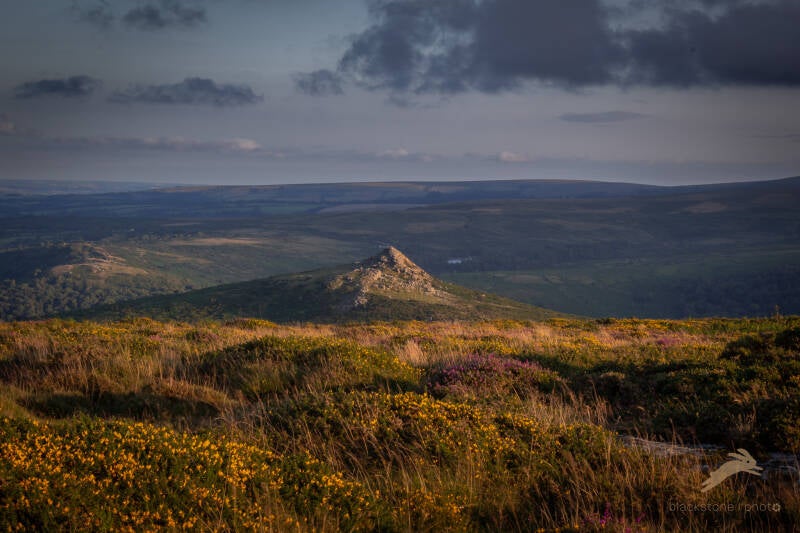
Sharp Tor & Venford Reservoir shot from Corndon Tor, 31 July, 19:15, 55mm, f/22, ISO100
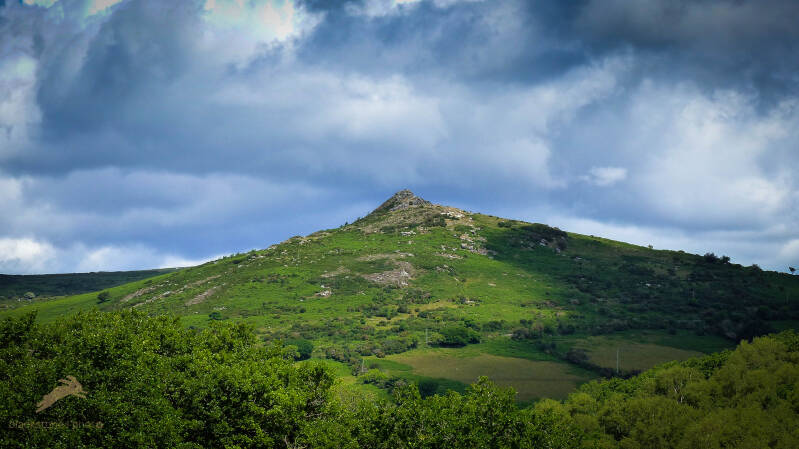
Summer storms - Sharp Tor shot from Venford Brook, 11th June, 10:15, 21mm, f/4, ISO 200

Mel Tor greets the dawn - 26th October, 08:20, 36mm, f/22, ISO 100
Add comment
Comments